A technical taxonomy of autonomous identity attacks. AI agents now execute the full fraud workflow: they observe, adapt, and retry without a person directing each move.
Identity fraud has a new execution model. Where attacks were once driven by human operators submitting fake documents or scripted bots replaying credentials, they are now being replaced by autonomous AI agents that run the full fraud workflow without human involvement at each step.
This document is a technical taxonomy of that threat class. It defines the framework, describes two distinct attack surfaces that require separate defenses, and catalogs ten techniques observed in production environments, each with a technical description, an observed scenario, and detection signals.
02Definition
What is agentic fraud?
Agentic fraud is a category of identity fraud in which the attack is executed by an autonomous software agent rather than a human operator. The agent finds targets, generates the synthetic media or documents required, submits them to verification systems, reads the outcome, and retries with adjusted parameters. The distinction from prior fraud automation is the feedback loop: the system observes what fails and updates its approach on its own.
Voice cloning, face synthesis, and document generation have each been commercially accessible since at least 2022. The shift is in how they are now combined: a single agent chains all three, runs the full sequence without human involvement, and does so across hundreds of parallel sessions at once. Earlier AI-assisted fraud required a person to direct each tool. The cost per attempt in agentic fraud falls to the cost of compute.
Every major generative AI capability released since 2022 was in active fraud use within months. The pattern is consistent: a tool goes public, fraud operations adapt it to identity attacks, and the cycle repeats faster each time. The timeline below tracks six milestones from ChatGPT to agentic AI, pairing each capability shift with the fraud application it enabled. Click any node to see both sides.
AI ships in public
Nov 2022
ChatGPT
You can't trust a message
Jan 2023
ElevenLabs
You can't trust a voice
Mar 2023
Midjourney v5
You can't trust a photo
Aug 2024
Face-swap tools
You can't trust a live call
Sep 2025
OpenAI Sora 2
You can't trust any video
We are here
Early 2026
Agentic AI
You can't trust there's a human at all
Fraud puts it to work
▲ what the public did with it
Agents that act on their own
Autonomous AI agents that plan, browse, message, and transact end-to-end, with no human at each step.
▼ what fraud did with it
Fraud that runs itself
Agents execute the full fraud workflow 24/7 — finding targets, generating synthetic media, submitting, adapting, retrying.
Each node marks a public AI capability milestone. Above the line: mainstream adoption. Below the line: how fraud operations adapted within months.
The scale of the problem is documented. These three figures capture where AI-enabled fraud stands today.
$20.9B
Reported US fraud losses, 2025
FBI IC3 Annual Report, 2025 Reported figures represent an estimated ~7% of actual losses (GASA / Feedzai)
4.5x
AI phishing click-through vs. human-written
Microsoft Security, 2025 54% vs. 12% click-through rate in controlled comparison
+1,900%
CAGR in payments to AI scam-service vendors
Chainalysis, 2024 Cryptocurrency flows to AI fraud infrastructure, 2021–2024
Definition
Agentic fraud is a class of identity fraud in which an autonomous AI agent, rather than a human operator, executes the full attack workflow. The agent observes system responses, updates its internal model, selects the next action, and retries at scale without human involvement at each iteration. The defining characteristic is this adaptive feedback loop, which drives attacks against both the media presented during verification and the integrity of the capture path itself.
03Framework
Significant change in the IDV Fraud execution model
Fraud analysis has historically organized attacks by artifact (what was faked) or by vector (how it entered the system). Both dimensions remain relevant. What AI has changed is the execution model, replacing human intervention with autonomous agents that observe, adapt, and retry.
An agentic attack is one where an autonomous software agent, not a human operator, executes the fraud loop. The agent observes system responses, updates its internal model, selects the next action, and retries. This cycle runs continuously, at scale, without human involvement in each iteration.
Manual fraud requires human effort and trial-and-error — slow, costly, less scalable. Agentic fraud generates, tests, adapts, and retries automatically; a continuous feedback loop drives improvement. Source: Incode — AIMS Workshop, CVPR 2026.
Three dimensions of any identity fraud attempt
A useful framework for classifying any identity fraud attempt uses three independent dimensions. Understanding each separately clarifies why agentic fraud requires a different defensive response than prior attack classes. A change in the execution model demands a change in the detection model.
Physical camera presentation, virtual camera feed, direct API upload, credential replay
Execution model
What drives the attempt
Human operator → scripted automation → adaptive AI agent with feedback loop
Why this matters for defense design
A human operator submitting a deepfake is bounded by their time and attention. An autonomous agent submitting the same deepfake, iterating across thousands of variants, learning which generation parameters pass the classifier, and running hundreds of parallel sessions, is a categorically different threat. Defenses designed for the human execution model will be systematically defeated by the agentic one.
Defensive implication
Systems should return the minimum amount of information in rejection responses. Every differentiating signal (error type, response latency, retry thresholds) becomes training data for the agent's model of the approval boundary.
A mature agentic operation typically starts with real media, making small incremental changes to probe system defenses and map which parameters trigger rejection. Once a vulnerability is identified, the operation scales: the validated attack pattern is deployed across hundreds of parallel sessions. By the time the financial loss event occurs, the attacker is operating on a valid credential issued to a fraudulent identity, often with no synthetic media involved in the triggering transaction.
3250%
Share of fraud that is AI-assisted — now and projected by year-end
Incode Q1 2026 Fraud Intelligence Report
+55%
Year-over-year growth in digital injection attacks
Incode data, 2025–2026
20,000
Fake IDs a single service could generate per day
OnlyFake, 2024 — $15 per document at volume
04Attack surfaces
Two distinct attack surfaces
Agentic fraud reaches identity verification systems through two fundamentally different paths. Each requires a distinct class of defense. The failure to distinguish them is one of the most common architectural gaps in current fraud programs.
Surface 01Pre-agentic baseline
Classical presentation attacks (PAD)
Physical artifact → real camera → verification system
Traditional liveness detection was built to stop presentation attacks: 2D artifacts (printed photos, screens), 3D artifacts (silicone or paper masks), and video replay attacks. These require a human physically present at a device. They cannot be fully automated at scale.
This is the pre-agentic threat model. It is documented here because PAD is the defense layer that agentic injection attacks are engineered to bypass entirely.
Required defense
Media authenticity detection: liveness analysis (PAD), deepfake classification, anti-spoofing
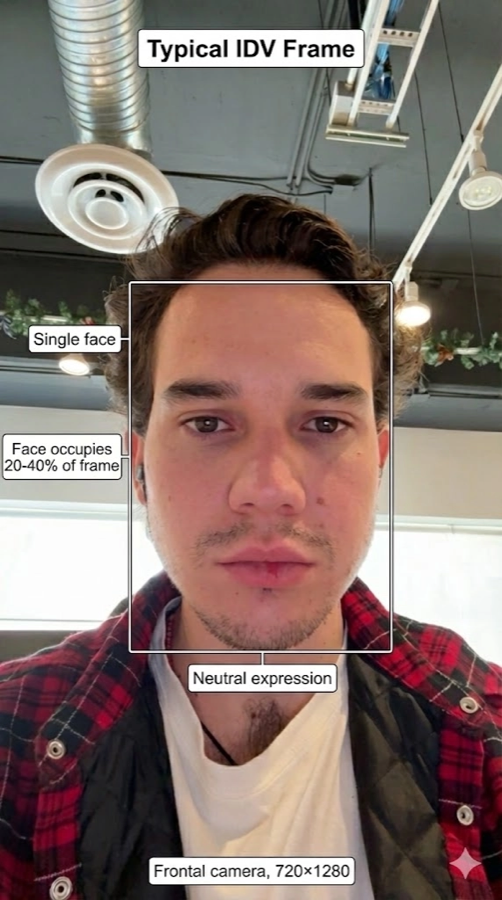
A typical IDV capture: single face, frontal, neutral expression, 720×1280. PAD defenses were designed for this capture path. Injection attacks bypass it entirely. Source: CVPR 2026 / Incode Mirage
Surface 02Primary agentic surface
Injection attacks
Media → bypasses capture path → injected directly into data stream
Agentic fraud simulates the entire capture environment through three primary methods:
01Virtual camera drivers routing synthetic video directly into the data stream, bypassing the physical camera entirely
02Man-in-the-middle interception capturing and modifying payloads between the SDK and the verification server before they reach analysis
03Emulated device environments running at scale on device farms, each mimicking a distinct real device fingerprint, sensor profile, and behavioral signature
These are separate attack surfaces requiring separate defenses. A strong liveness detector stops classical presentation attacks (PAD) and provides no protection against injection attacks. A capture path integrity check stops injection attacks and provides no protection against sophisticated deepfakes delivered through real hardware. Both defenses are necessary. A fraud program that deploys only one has left exactly half its attack surface undefended, and an agentic attacker's feedback loop will locate that half efficiently.
05Technique taxonomy
Ten documented attack techniques
The following techniques represent the current generation of agentic identity fraud as observed in production environments. They are not mutually exclusive: a single fraud operation typically combines multiple techniques across different stages of the attack chain.
A/B test against live systems. Map the approval boundary. Stay below rate-limit thresholds.
AFT-05 · AFT-07 · AFT-08
→
Stage 4 — Scale
Deploy across many institutions. Regenerate whatever gets blocked. Parallel sessions, mule activation.
AFT-05 · AFT-07 · AFT-10
Four-stage execution model observed in production agentic fraud operations. Each stage corresponds to a cluster of techniques in the taxonomy below. Source: Incode threat intelligence / Agentic Fraud Technical Taxonomy
Tool inventory — available at each pipeline stage
Stage 1
Collect
Stage 2
Create
Stage 3
Test
Stage 4
Scale
Data broker APIs
Leaked credential sets, PII databases, OSINT scrapers. Used to build target profiles and seed synthetic identity generation.
Diffusion model generators
Fine-tuned SDXL and similar models for IDV-domain face synthesis. Document editors for field-level modification. Voice cloners (ElevenLabs and equivalents).
Virtual camera drivers
OBS, ManyCam, and custom kernel-level drivers that route synthetic video into the capture stream. Emulated device environments with distinct hardware fingerprints.
Session multiplexers
Proxy rotation, residential IP pools. Browser automation (Playwright, Puppeteer) to simulate distinct user sessions. Mule account managers for fund routing.
Browser automation
Playwright, Puppeteer, and Selenium for scripting form fills and submission flows across target institutions.
Face swap tools
Real-time face swap for liveness challenge response. Pre-recorded segments indexed to prompt types (blink, turn left) with prompt synchronization scripts.
API probing tools
Direct API calls bypassing SDK capture flow. Timing analysis scripts to map response latency patterns and identify step-up thresholds.
OTP handlers
SIM swap infrastructure, SS7 exploitation, and real-time OTP interception for bypassing step-up verification during scaled deployment.
Each stage runs its own tool selection logic. After a rejection, the agent reads the signal — error type, response latency, which step triggered the block — and maps it to a failure category. It then selects the next tool from that category. If no available tool clears a step, the pipeline can query external sources or a retrieval layer to discover and integrate a new one. This is the adaptive mechanism that makes agentic fraud structurally different from scripted automation.
Tool inventory framework: Dr. Shu Hu, Purdue University Machine Learning and Media Forensics (M2) Lab. Production tool observations: Incode threat intelligence.
Synthetic generation in practice
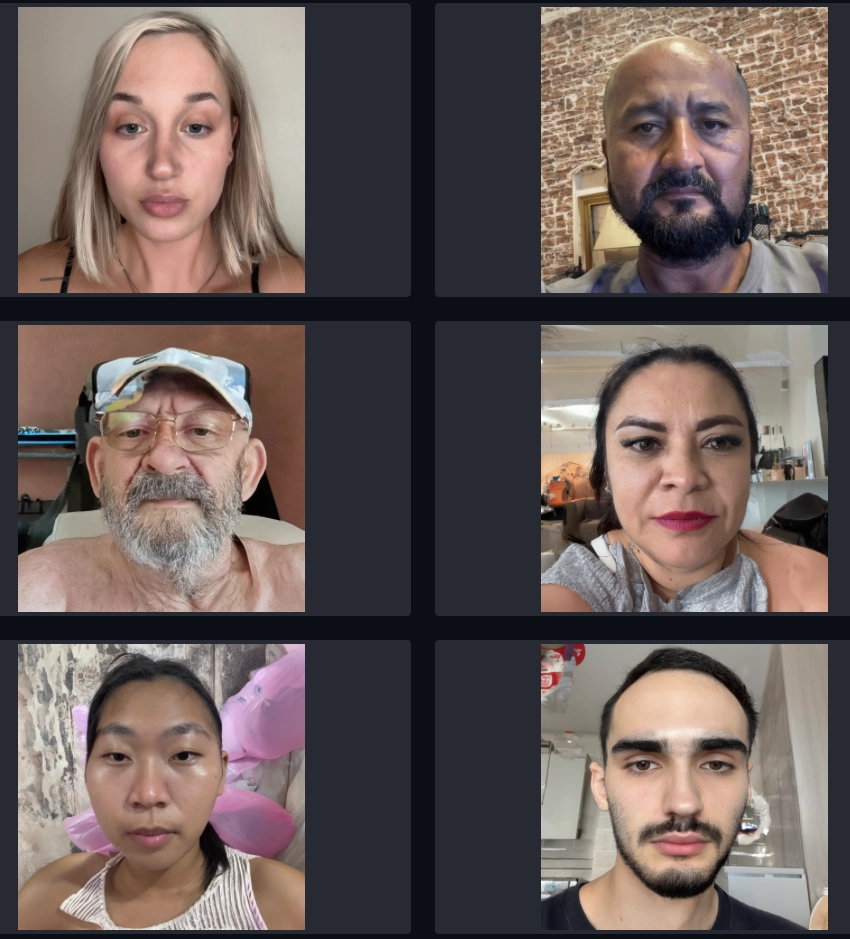
Base SDXL — generic "selfie" prompts. Outdoor backgrounds, studio lighting, high-end rendering. Caught by IDV detectors trained on KYC distributions.
IDV-domain fine-tuned — same prompts, generator fine-tuned on KYC capture data. Mobile camera quality, indoor lighting, realistic imperfections. APCER rises from 0.0000 to 0.905 against production detectors.
AFT-01 — Synthetic media generation
DFaaS rings operate fine-tuned generators — not commodity models. The gap between these two outputs is why IDV-domain fine-tuning breaks detectors trained on public benchmarks.
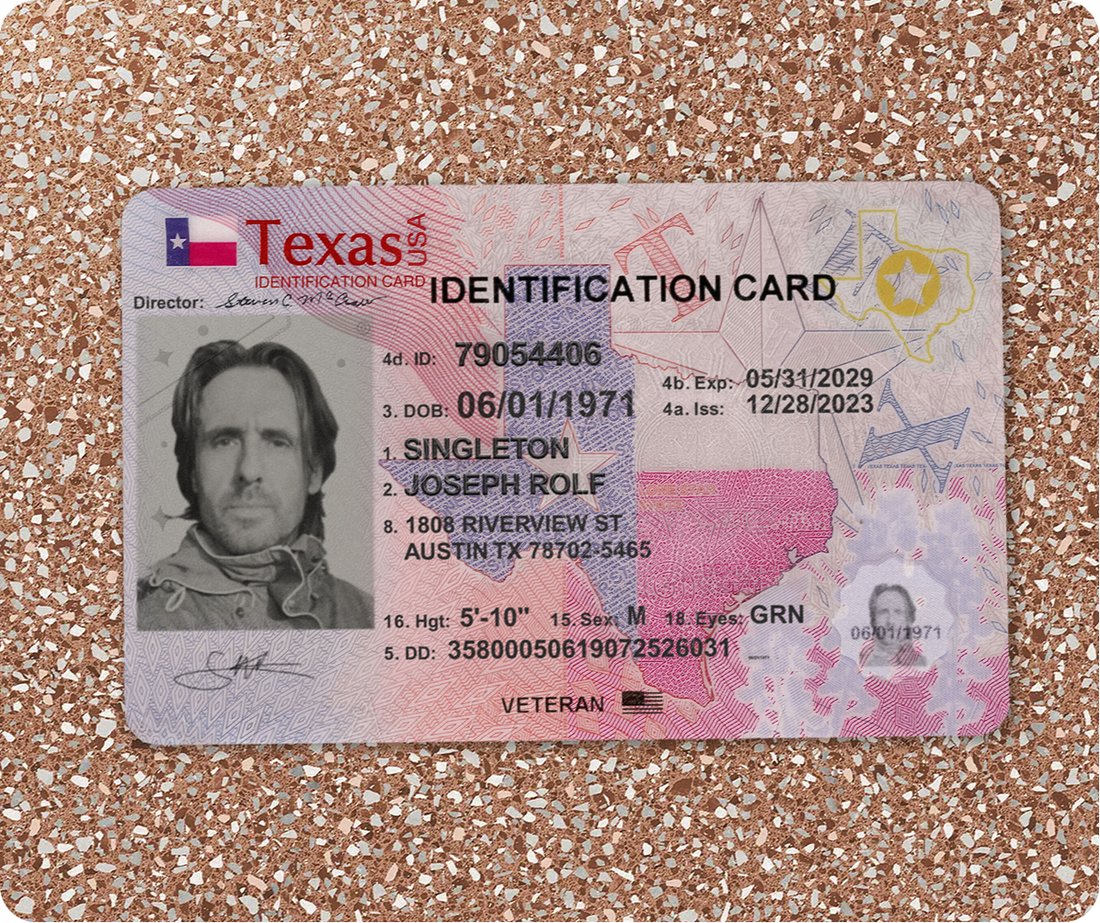
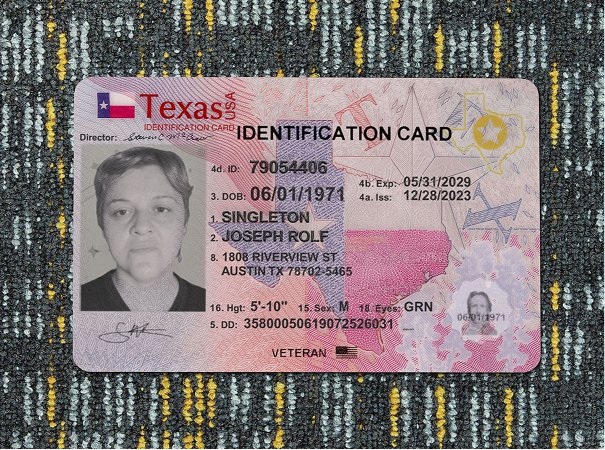
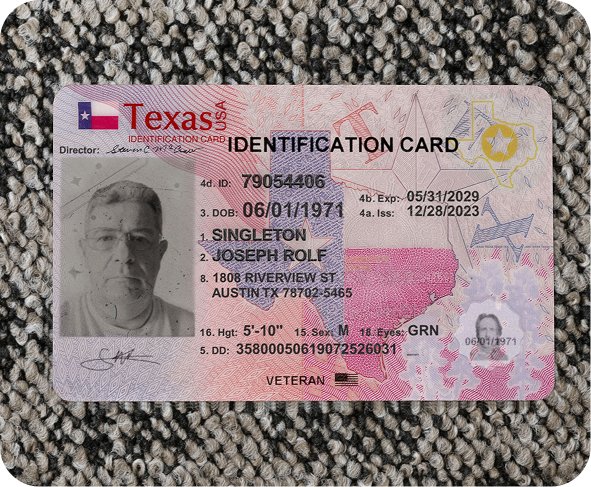
Three generations of the same document. The base is a real credential. Each iteration modifies one field — name, date of birth, ID number — while preserving fonts, barcode encoding, holographic overlay placement, and machine-readable zone formatting. The result passes optical document verification because the structural signals are authentic.
The fraud operation does not forge from scratch. It edits real documents, one parameter at a time, to produce variants that survive cross-reference checks against public records. At $15 per document, a single service can produce 20,000 of these per day.
Document cloning: three generations of a synthetic Texas ID test document built for this research. The identity fields (name, DOB, ID number) are held constant while the enrolled photo is substituted between generations. Source: Incode threat intelligence.
(Select any technique for technical detail, observed scenario, and detection signals.)
06Attack operations
How techniques combine into operations
Individual techniques rarely operate in isolation. A mature agentic fraud operation runs multiple techniques in parallel, organized into functional roles. The Collect–Create–Test–Scale model describes how these roles interact.
01
Collect
Automated agents query breach databases, darknet markets, and public data sources for leaked PII: names, SSNs, dates of birth, addresses, passwords, and security question answers.
The output is a ranked target list sorted by which identity fragments are most likely to pass which financial products, produced overnight at a cost measured in dollars, not hours of manual labor.
Corresponds to AFT-01 (DFaaS sourcing), AFT-06 (SSN harvesting for synthetic ring construction), and AFT-09 (biometric data scraping from social media).
02
Create
Generates complete synthetic identity packages: name, address history, employment record, supporting documents. All components are internally consistent and capable of withstanding cross-reference checks.
Produces deepfake video responding to liveness prompts, clones voices for support-line impersonation, and fabricates documents with accurate fonts, barcodes, and machine-readable zones.
Corresponds to AFT-02 (document forgery), AFT-03 and AFT-04 (deepfake video production), AFT-06 (synthetic identity assembly).
Capture pipeline injection
The Create role doesn't only generate media. It also sets up the injection infrastructure: virtual camera drivers, tampered SDK builds, and emulated device environments are configured here, before the Test role validates them against live targets. See AFT-03 and AFT-04.
03
Test
Runs systematic A/B testing against live targets, holding all variables constant except one per run: same identity with a different photo crop; same application flow with a different device fingerprint.
Operates within normal traffic volumes so no rate limit or anomaly alert fires. Each attempt appears as a distinct, unrelated user session.
Calibrates keystroke cadence, mouse movement curves, and form interaction patterns to match behavioral profiles that monitoring systems associate with real human sessions.
Corresponds to AFT-05 (farming orchestration), AFT-08 (KYC timing analysis), and the Test stage of AFT-07 (per-institution profiling).
04
Scale
Deploys validated patterns simultaneously across targets, platforms, and channels. When a pattern is blocked, the system automatically regenerates identity packages and adapts parameters.
Specialized sub-agents run in parallel: one handles document submissions, one manages liveness sessions, one handles support-line calls, one routes fund transfers.
Corresponds to AFT-05 (parallel farming), AFT-07 (multi-institution rotation), AFT-10 (mule network activation and fund routing).
The cheapest-path principle
The agentic attacker is not attempting to defeat the strongest control in the system. It is finding the weakest stage. If account opening is well-defended but account recovery is not, the operation migrates to recovery. If the liveness check is robust but transaction monitoring is permissive, the operation opens legitimate-looking accounts and exploits them post-enrollment. The feedback loop finds the minimum-cost path through the system as a whole, not through any individual control.
The adaptive loop
Why the feedback loop defeats static detection
The mechanism enabling cost-per-attempt reduction is a continuous feedback loop. Each cycle produces information that improves subsequent attempts. Understanding the loop structure is prerequisite to understanding why static threshold-based detection fails against it.
1
Estimate
2
Choose
3
Submit
4
Observe
5
Update
State modeling
Estimate
The agent maintains an internal model of the target system: which controls are active, what the approval criteria appear to be, where friction has been encountered in prior attempts. The estimate is initialized from prior runs against this or comparable systems and is updated after every observation.
Information leakage
Error message: "document not accepted" ≠ "face match failed". Rejection latency: 180ms ≠ 3,200ms. Retry boundary: attempt 3 triggers additional verification, attempt 2 does not. Every differentiating signal in a system response is training data for the attacker's estimate model. The loop converges toward a complete map of the approval boundary without triggering rate limits, because each attempt appears as a distinct user session.
07Detection model
Three questions fraud systems must keep separate
Most identity verification systems were designed around a single question: is this person who they say they are? Agentic fraud exploits the conflation of three distinct trust questions, each of which can be answered independently and each of which has different failure modes when systems treat them as one.
How agentic fraud maps your defenses
During the Test phase, agentic operations statistically map each defense control, identifying which are deterministic (binary pass/fail — a fixed rule that always produces the same outcome) versus probabilistic (threshold-based models that vary by input). Deterministic controls are reverse-engineered quickly. Probabilistic controls require more attempts but can still be mapped through variance analysis across sessions. An attacker who knows which controls are which can allocate probing effort efficiently and route attacks to exploit probabilistic controls where confidence thresholds can be gamed.
Deterministic
Is this actor authorized to take this action?
A permissions question, not an identity question. The credential is either valid for this action or it is not. Answerable with cryptographic certainty. Failure mode: credential theft, session hijacking, forged authorization tokens.
Probabilistic
Was the evidence used to establish this identity trustworthy?
A question about verification quality at enrollment or last re-verification. Answerable only probabilistically, to a confidence level appropriate to the transaction risk. Failure mode: synthetic identity, deepfake at enrollment, injection attack during KYC.
Probabilistic
Does this action make sense given the full behavioral context?
A behavioral and graph question. Even valid credentials issued against genuine identity evidence can be associated with anomalous activity patterns. Requires session history, cross-account graph analysis, and transaction context. Failure mode: account takeover of legitimately-verified identity, mule network activity.
The conflation exploit
A passed liveness check answers a narrow sub-question of Question 2: a live person was likely present through an acceptable capture path at this moment. It does not establish that the person is who they claim to be, that their documents are genuine, that any agent acting on their behalf is authorized, or that the transaction is consistent with their behavioral baseline. Treating a passed liveness check as the answer to all three questions creates the exploitable gap that AFT-03, AFT-04, AFT-09, and coordinated mule operations use as their entry point.
Mitigation principles by question
Questions 1 + 2 — Capture and verification layer
Separate capture path integrity from media authenticity. Deploy both independently. A system that only checks media quality will fail against AFT-03 and AFT-04. A system that only checks device attestation will fail against AFT-01 and AFT-02.
Minimize information leakage in system responses. Every differentiating signal in an error message or response time is a training signal for the attacker's estimate model. Responses to external requestors should contain the minimum detail necessary for legitimate use.
Re-verify at material risk events. Not every action requires equal assurance. Tier re-verification to events where the risk profile changes: new payee, elevated transaction amount, account recovery, new device, irreversible action.
Question 3 — Behavioral and graph layer
Correlate signals across sessions and accounts. Device fingerprint reuse, velocity patterns inconsistent with plausible human behavior, account recovery clustering around high-value transactions: these are invisible to point-in-time checks. Graph analysis surfaces AFT-07 (impersonation chains) and AFT-10 (mule networks) that individual-account analysis cannot.
Measure defense as a system, not as individual controls. A step-up verification that stops fraud at account opening and drives it to account recovery has not reduced fraud loss. Evaluation should track attacker cost across the full operation chain: attempts to first success, information leaked per rejection, which stage becomes the path of least resistance after each defensive improvement.
Adapt with 20-30 samples, not thousands
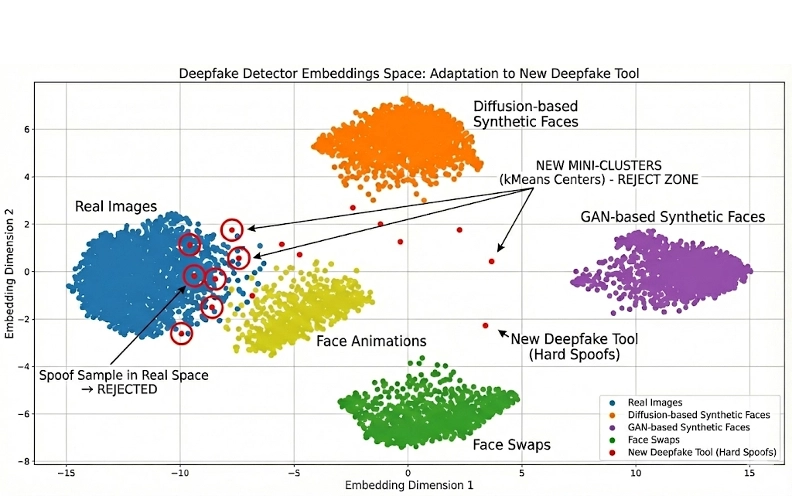
Detector embedding space
UMAP projection: real images, diffusion-based synthetic, GAN-based synthetic, face animations, and face swaps occupy distinct regions. A new unseen tool (Nanobanana Pro, red) lands in a separate region the detector had not encountered in training.
Adapting to cover a new cluster requires 20–30 labeled samples — not thousands.
Source: CVPR 2026 / Incode, Efim Boieru et al.
The UMAP visualization above shows a detection system that can adapt to new tools. But adaptation speed is only meaningful if you can measure the attacker's adaptation speed too. Dr. Shu Hu (Purdue University) argues that standard evaluation metrics, designed for static attack samples, don't capture how agentic attacks actually behave. He proposes five metrics built around the feedback loop itself:
Measuring agentic attacks — proposed metrics
Dr. Shu Hu (Purdue University) proposes five metrics that better reflect how these operations actually behave:
Metric 01
Attempts to first success
How many attack iterations before the agent passes a verification step.
Metric 02
Information leaked per rejection
How much the system reveals about its decision logic through each rejection response.
Metric 03
Convergence speed
How quickly the agent maps the approval boundary under query-based adaptation.
Metric 04
Attacker cost after defensive change
How much effort the attacker must spend to recover after a defense is updated.
Metric 05
Robustness under adaptation
Whether a defense holds as the attacker iterates, or degrades predictably over queries.
The fairness dimension
Identity verification systems operate across diverse populations, devices, lighting conditions, and demographic groups. A fraud defense that is strong on average but uneven across demographic subgroups creates both security and fairness risks. Attackers can exploit the weaker regions of a detection model, while legitimate users from underrepresented groups face higher false rejection rates. These failure modes compound each other.
Observation: Dr. Shu Hu, Assistant Professor, Purdue University
On adaptive defense
Static classifiers evaluated against historical attack samples produce a bounded defense. An agentic attacker's feedback loop will, over sufficient iterations, identify and exploit the gap between the training distribution and the current attack space. The analog to the attacker's Test role is internal adversarial testing: deliberately generating new attack variants against your own systems in controlled conditions, before those variants appear in production fraud. This is the principle behind spoof bounty programs for liveness detection. It applies to the full identity verification chain.
08Research perspectives
Where the threat is heading
The techniques in this taxonomy reflect what fraud operations are doing now. The research question is what happens as both sides adapt. Dr. Shu Hu, Director of the Machine Learning and Media Forensics (M2) Lab at Purdue University, studies exactly where detection breaks down in production — and what that means for how the field needs to evolve.
Contributor perspective — Dr. Shu Hu, Purdue University
Current fraud operations are already optimizing for passing specific institutional controls rather than producing output that looks convincing to a human. That changes the detection problem. A classifier trained to identify visual artifacts will lose ground against agents that have learned to pass it. What matters is whether the pattern of behavior across sessions, devices, and institutions is consistent with a real user — a distributed signal that no single institution observes in full, and that runs directly into data sharing constraints between organizations.
"Future fraud agents will not optimize for visual realism alone. They will optimize for passing a target institution's specific controls. The attack objective becomes operational success, not human perceptual quality."
This points toward a new research discipline Dr. Hu calls agentic media forensics: moving beyond artifact detection in individual images, video, or documents, toward modeling the full fraud operation as a system. Two of his published papers trace how this shift is already playing out. His benchmark research shows why detectors that perform well on curated academic datasets fail in deployment — attackers find the gap between the test set and production, and optimize around it. His fairness research shows the same dynamic from a different angle: models that underperform on certain demographic subgroups create entry points that attackers exploit, while legitimate users absorb the cost in false rejections.
"This taxonomy suggests a research direction I would call agentic media forensics: moving beyond detecting whether a single image, video, or document is fake, toward modeling the full fraud operation."
Dr. Shu Hu is Assistant Professor in the School of Applied and Creative Computing at Purdue University and Director of the Purdue Machine Learning and Media Forensics (M2) Lab. Ph.D. in Computer Science and Engineering, University at Buffalo (SUNY). Post-Doctoral Fellow, Heinz College, Carnegie Mellon University.
From taxonomy to trust
This taxonomy is a living document, shaped by what Incode has observed across billions of identity verifications. That same expertise powers our agentic identity solution, built to verify, tokenize, and monitor AI agents at scale.
This taxonomy treats agentic fraud as its own threat category in identity verification. The framework draws on production fraud analysis, academic deepfake detection research, and AI agent deployment observations. It is intended to give security engineering, fraud, and identity teams a shared technical vocabulary for a threat class vendor literature and industry standards haven't caught up to yet.
EB
Efim Boieru
Deepfake detection research
Senior Manager of Machine Learning at Incode. Lead author on the Incode Mirage dataset and CVPR 2026 research on IDV-domain fine-tuning and detector robustness.
Chief Technology Officer and co-founder at Incode. Contributed the agentic deployment model, which describes how fraud operations use autonomous agents to observe, adapt, and retry at scale.